

Buying a Silent Generator for international projects involves more than comparing prices and decibel ratings. A generator that performs well on a construction site may fail in a hospital, hotel, or remote factory. Global buyers must match output, voltage, frequency, fuel type, and duty cycle with the destination’s operating conditions. Small details matter. A 50 Hz model cannot simply replace a 60 Hz unit without checking connected equipment. Likewise, a low noise figure may be measured under conditions that do not reflect real operation.
Practical experience shows that reliable purchasing begins with documented specifications and direct supplier questions. Ask for sound measurements, load-test records, alternator details, controller functions, and cooling performance. Check whether the enclosure protects against dust, rain, and high humidity. Review warranty coverage, spare-parts availability, installation guidance, and response times before placing an order. Certification requirements also vary by market, so local electrical, emissions, and safety rules deserve careful verification. A professional supplier should explain these differences clearly, not hide behind a polished brochure.
There is no perfect machine.
Fuel quality, ambient temperature, altitude, and maintenance skills can change performance. Buyers sometimes focus too heavily on purchase cost and overlook transport, commissioning, and long-term servicing. That mistake can become expensive. Even experienced teams occasionally miss a frequency mismatch or underestimate starting loads. Careful comparison, realistic site data, and an independently witnessed test can reduce those risks. These ten buying tips provide a practical framework for evaluating a Silent Generator with greater confidence, while leaving room for honest questions and necessary reconsideration.
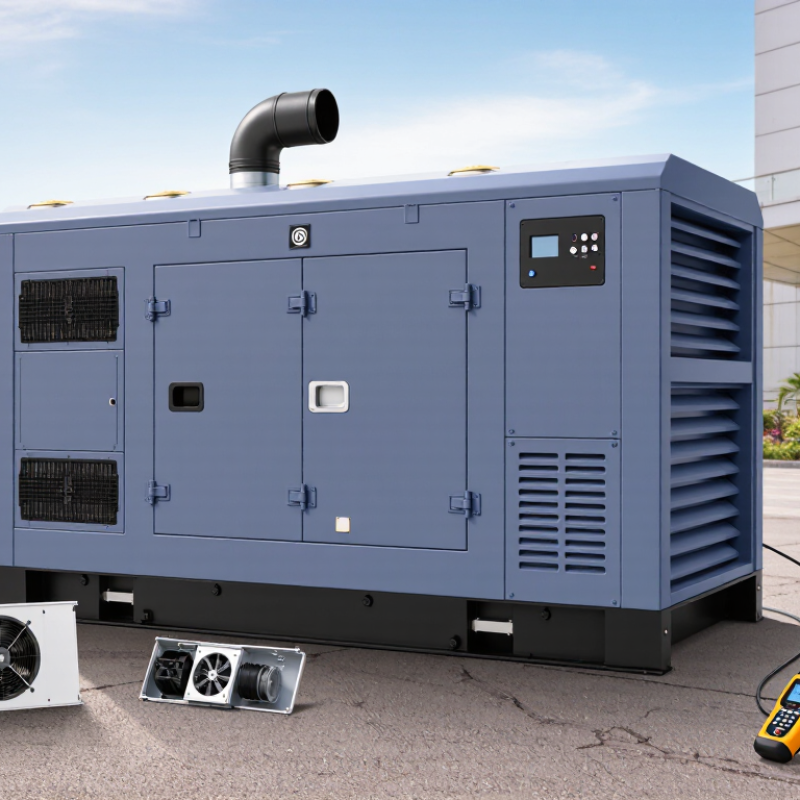
When buying a silent generator internationally, define the load before comparing enclosure, fuel tank, or noise ratings.
The key conversion is simple: kW equals kVA multiplied by power factor. At the standard 0.8 power factor, a 100 kVA generator supplies about 80 kW of real power. Conversely, an 80 kW requirement needs roughly 100 kVA. Keep the units visible.
I have seen buyers size equipment only from nameplate watts. That approach can fail when motors, pumps, compressors, or transformers start. Record running kW, starting current, and sensitive electronic loads separately.
A 125 kVA set may provide 100 kW at 0.8 power factor, but output can fall at high altitude or high ambient temperature. Check the supplier’s derating table. Do not treat the calculation as a guarantee. It is a starting point.
Leave practical headroom for future equipment and temporary surges. Many projects target about 70–80% of rated capacity, but the correct margin depends on duty cycle and load profile.
Ask for test data at your expected voltage, frequency, and power factor. Confirm continuous or standby rating, phase balance, and local electrical requirements. A qualified electrician should verify the final selection.
Small errors become expensive. I still recheck every figure against measured loads, because spreadsheets can look precise while assumptions remain weak.
Global buyers often compare noise ratings first, but frequency compatibility deserves equal attention. A 50 Hz generator may run at a different engine speed than a 60 Hz model. That difference affects motors, pumps, transformers, and sensitive control systems. Never assume voltage alone proves compatibility. Confirm frequency, phase, voltage, and rated speed with the equipment manual. Short checks prevent expensive rewiring.
ISO 8528-5 adds a practical performance lens. Its G1 through G4 classes describe how well a generating set handles voltage and frequency changes under load. G1 suits less demanding loads, while G3 or G4 may suit electronic or rapidly changing loads. The exact requirement depends on the installation, not the brochure. Ask for step-load results, recovery time, allowable deviations, and test conditions. A load-bank report is stronger than a vague “stable output” claim.
Acoustic performance is separate. A quiet enclosure can reduce sound while the alternator still responds poorly to sudden load changes. Request dB(A) data at a stated distance, operating load, and site temperature. In humid or hot regions, derating can reduce available power. Leave space for ventilation and maintenance access. The cheapest 60 Hz unit may fail when a 50 Hz pump arrives later. That oversight is easy to make. Have an independent technician verify nameplates, protection settings, and witnessed testing before shipment.
Compare 50 Hz and 60 Hz output with ISO 8528 performance classes
Basic loads such as lighting and general-use equipment.
Loads comparable to a public utility supply, with limited voltage and frequency variation.
More demanding loads requiring improved voltage and frequency performance.
Exceptional applications where performance parameters are especially critical.
The chart uses the synchronous-speed relationship n = 120 × f ÷ poles: a four-pole alternator runs at 1,500 rpm at 50 Hz and 1,800 rpm at 60 Hz, while a two-pole alternator runs at 3,000 rpm and 3,600 rpm respectively. ISO 8528 G1–G4 are performance classifications, not universal wattage ratings; select the class according to the sensitivity and starting characteristics of the connected loads.
A quiet generator starts with a credible measurement, not the word “silent.” ISO 3744 determines sound power from sound-pressure readings around the equipment. However, many specifications report sound pressure at seven metres. These values are not interchangeable. Ask for the test geometry, operating load, microphone height, weather conditions, and background-noise correction.
Check the dB(A) value at 25%, 50%, 75%, and 100% load. A unit may sound acceptable during a light-load test, then become noticeably louder near full output. In open conditions, sound pressure usually falls by about 6 dB when distance doubles. Walls, concrete, and nearby buildings can change this result. Small details matter. Verify whether the reading used a reflecting surface, as ISO 3744 commonly requires. A seven-metre figure without these details is incomplete.
The European Environment Agency reported in Environmental Noise in Europe 2020 that more than 113 million people faced road-traffic noise above 55 dB Lden. This is not a generator-specific limit, but it shows why site noise deserves serious review. WHO’s 2018 guidelines recommend keeping road-traffic noise below 45 dB at night. Local rules may differ. Treat these figures as planning references, not automatic compliance guarantees. One practical weakness remains: published laboratory results may not match a generator beside a building, under rain, or after maintenance intervals. Request an independent test report when the project is noise-sensitive.
Before approving a generator, match its engine power band to the correct emissions standard. U.S. EPA Tier 4 Final requirements vary by rated power, while EU Stage V also applies particle-number limits in several categories. EPA regulations commonly show a particulate-matter limit of 0.02 g/kWh for many 56–130 kW engines. Stage V often tightens this to 0.015 g/kWh. Check the exact table.
Do not trust a sales label alone. Request the engine certificate, test-cycle results, rated power, and after-treatment details. The governing references are U.S. EPA 40 CFR Part 1039 and European Regulation (EU) 2016/1628. The European Commission’s Stage V technical documents emphasize both mass emissions and particle numbers. A generator may meet the mass limit yet fail another requirement. Small details matter.
Inspect the nameplate in person. Confirm the serial number matches the certificate. Ask whether the engine needs diesel particulate fluid, low-sulfur fuel, or scheduled filter regeneration. Poor fuel quality can damage after-treatment systems, especially at dusty construction sites. I have seen buyers compare only kilowatts and purchase the wrong compliance class. That mistake is expensive. Certification documents can also be incomplete, so independent verification is worth the delay. EPA and European Commission publications should guide the final check, not a translated brochure.
10 Silent Generator Buying Tips for Global Buyers
A quiet generator can still become expensive when fuel use is measured poorly. During site testing, record consumption at 25%, 50%, and 80% load. The 80% figure often shows the most practical operating efficiency. Check litres per hour, not only advertised runtime. A large fuel tank may hide inefficient performance. Keep a simple log. It reveals patterns after several workdays.
Tips: Ask for a verified fuel-consumption test at 80% load. Request sound readings at a stated distance and operating condition. Confirm whether the rating applies to standby or prime power. These details are easy to overlook. I once compared two units using different test loads, which made the results nearly useless.
Service access matters in remote locations. Inspect whether filters, belts, batteries, and control panels are reachable without removing major covers. Ask for service intervals, troubleshooting guides, and training materials in a usable language. Confirm local technician coverage before shipment. Global spare parts should include common filters, sensors, fuses, and starter components. Check part numbers, packaging, shelf life, and delivery routes. A technically excellent machine may sit idle if one small sensor takes weeks to arrive. Availability sounds simple, but it is often the weak point.